Imagine asking someone in 1995 what made a company valuable. The answer would probably be straightforward. Factories. Machinery. Land. Inventory. These were the assets businesses proudly displayed on their balance sheets.
Now ask the same question in 2026. The answer sounds very different. Data. Algorithms. Software. Brands. Patents. Customer relationships. Research pipelines. Employee expertise.
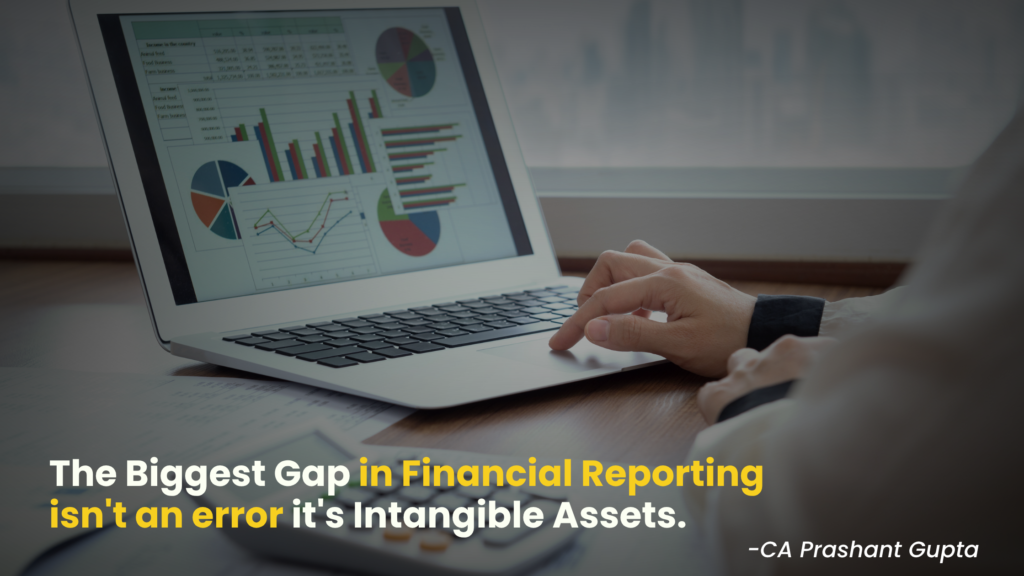
Ironically, many of these are the very assets that don’t fully appear on financial statements. How did we get here?
The Balance Sheet Was Built for a Different Economy
Accounting standards were developed in a world where value was largely tangible. If a company bought a machine, there was clear evidence of a purchase price, ownership, and an expectation of future economic benefit.
Recognising it as an asset was relatively simple. But today’s economy creates value differently. A pharmaceutical company spends years researching a breakthrough therapy. A technology company invests millions building an AI model. A consumer brand earns customer loyalty over decades.
These investments often create enormous business value. Yet accounting frequently records much of that spending as an expense. The result is that a company’s most valuable assets may never appear on its balance sheet.
Is Accounting Getting It Wrong?
Not necessarily. In fact, accounting standards are solving a much harder problem. Imagine allowing every company to recognise its brand value, employee talent, customer loyalty, or future innovation as assets.
Who decides the value?
How do you verify it?
How do auditors challenge management’s assumptions?
Could companies inflate profits simply by assigning optimistic values to internally created assets?
Financial reporting would quickly become less reliable. Accounting standards therefore make a deliberate trade-off. They would rather understate uncertain assets than overstate them. Reliability often takes precedence over optimism.
The Cost of Conservatism
This conservative approach creates a growing gap. Market value increasingly exceeds book value. Because investors value assets that accounting often cannot recognise. A pharmaceutical company’s pipeline. A software company’s code. A platform’s network effects. A brand’s reputation.
The balance sheet captures yesterday’s verified investments. The market prices tomorrow’s expected opportunities. Neither is necessarily wrong. They simply answer different questions.
Why This Matters More Than Ever
The rise of artificial intelligence has made this challenge even more obvious. What is the value of a proprietary AI model? Or decades of accumulated business data? Or an organisation’s specialised knowledge?
These resources may define a company’s competitive advantage. Yet many fail to meet the strict recognition criteria required under accounting standards. As economies become increasingly knowledge-driven, the gap between economic value and accounting value is likely to grow.
The Bigger Lesson
The purpose of financial reporting has never been to estimate what a company is worth. Its purpose is to report what can be measured with reasonable confidence. That’s an important distinction.
Investors often use financial statements as a starting point, not the final answer. The numbers provide a foundation. Judgement, strategy, innovation, and future potential complete the picture.
Final Thought
Perhaps the most valuable lesson isn’t that accounting ignores intangible assets. It’s that accounting refuses to recognise value it cannot verify. In a world where ideas often matter more than buildings, that can make financial statements appear incomplete.
But maybe they were never meant to tell the entire story. They were meant to tell the part of the story that can be trusted. And perhaps that’s why the notes, disclosures, and management commentary have become just as important as the balance sheet itself.
Because the most valuable assets in modern business may not be missing from the company. They may simply be missing from its financial statements.