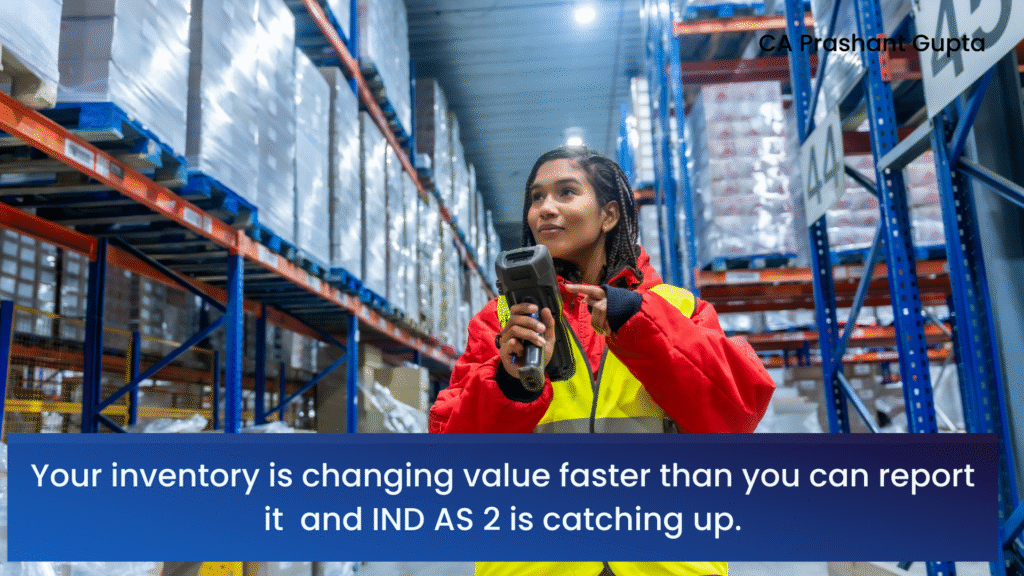
For years, inventory accounting under IND AS 2 felt straightforward.
You bought goods, you valued them at cost or NRV (Net Realisable Value), and you moved on.
Commodity prices are swinging so sharply that many companies are discovering a hard truth:The biggest risk to your P&L today may be sitting quietly inside your inventory line.
And this is not just a problem for metal companies or real estate developers,even mid-sized manufacturers, traders, and D2C brands are feeling the heat.
Why Is Inventory Suddenly a High-Risk Item?
Steel prices have seen double-digit swings multiple times in FY24–FY25.Crude-linked materials (plastics, chemicals, packaging) are moving weekly.Construction materials like cement and aluminium are reacting to infra projects and global demand.
These fluctuations directly impact NRV testing, which IND AS 2 requires at every reporting date.
For many companies, NRV testing used to feel like a formality.
In 2025, it has become a full audit exercise.
IND AS 2 Assumes “Stable Markets.” Today’s Markets Are Not Stable.
IND AS 2 was built on a practical assumption
that selling prices don’t collapse drastically within a few weeks.
In today’s environment:You may buy raw materials at ₹100,Price falls to ₹85 within 45 days,but your final product selling price hasn’t increased
Your inventory is suddenly worth less than your cost and IND AS 2 requires you to book an immediate loss.
Real Estate & Infrastructure Are Feeling the Pressure
Under IND AS, work-in-progress (WIP) in real estate is highly sensitive to:Cement price volatilitySteel price volatility,Design changes,Contract renegotiations
A dip in possible selling price or a rise in completion costs can trigger NRV reduction.
In 2025, many real estate companies reported higher NRV risk due to:Slower demand in tier-2/3 cities,Higher input costs,Delays in approvals,Competitive pricing pressure and more frequent impairment triggers.
Banks & Lenders Are Now Looking at Inventory More Closely
Because commodity-linked industries are under pressure, lenders are asking:How recent is your NRV calculation?
Have you impaired overstated stock?,Is your inventory genuinely saleable?How reliable are your market price inputs?
This means your inventory valuation directly affects:Working capital limits, Renewal negotiations,Credit rating,Loan covenants
Many Mid-Sized Businesses Are Missing This Key Point
If prices fall after the reporting date but before financial statements are approved, auditors may require adjusting events.This is catching many companies off-guard.
Example:
A chemical trader valued inventory at ₹120/kg on 31 March.
Market dropped to ₹105/kg by 15 April.
Financial statements were approved in May.Under IND AS 10, this event is adjusting, meaning the loss must be recognised in 31 March financials.
Conclusion
Inventory is no longer a passive number on the balance sheet.
In 2025, it has become a live risk, influenced by external volatility that companies cannot fully control and when markets move, IND AS 2 moves with them.
Because in a world where commodity prices change weekly,
the question is “What is the cost of inventory?”…but can we actually recover that cost?”