Why inventory can suddenly be worth less even though nothing physically changed
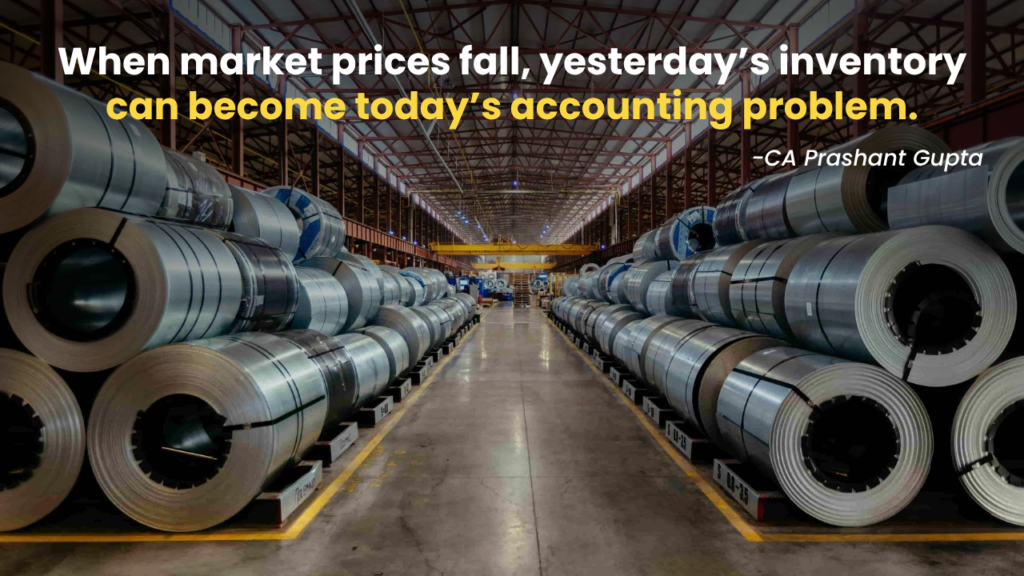
Imagine a steel manufacturer closing its books at year-end. The warehouse looks exactly the same as it did three months ago.
Same steel coils. Same quantity. Same quality. Same storage location. But there is one big difference. Steel prices have fallen. And suddenly, the finance team has an accounting question: Is the inventory still worth what we paid for it?
This is where a change in the market can become an accounting issue.
The Physical Inventory Hasn’t Changed. Its Economic Value Has.
This is one of the interesting things about inventory accounting. We often think of an asset losing value when something happens to it physically. A machine breaks. A building deteriorates. A product gets damaged.
But inventory can lose value even when nothing happens to the inventory itself. If market conditions change and the amount the company expects to recover from selling that inventory falls below its carrying amount, the financial statements may need to reflect that decline.
For a steel company, a significant fall in steel prices can therefore have a direct impact on reported profitability.
Here’s a Simple Example
Suppose a company purchases steel inventory for ₹100 crore. At the reporting date, steel prices have fallen significantly. The company now estimates that it can recover only ₹90 crore from the inventory after considering the relevant selling and completion costs.
The warehouse hasn’t changed. The accounting question has. The company may need to recognize a ₹10 crore write-down so that the inventory isn’t carried above the amount expected to be recovered from it.
And that ₹10 crore doesn’t simply disappear from an Excel sheet. It can affect the company’s profit, margins, asset values and management’s view of performance.
This Is Where Management Judgment Matters
The difficult question isn’t: “Did steel prices fall?” That’s easy to observe. The harder question is: “What can we realistically recover from this inventory?” Finance teams may need to consider:
- Current selling prices
- Expected selling prices
- Costs required to complete the product
- Costs necessary to sell it
- Whether the inventory is slow-moving
- Whether there are committed customer orders
- Whether the decline in prices is temporary or sustained
This is where accounting moves beyond simply recording transactions. It requires judgment about economic reality.
And Here’s the Interesting Part
A company could have: More inventory than last year. The same physical inventory quality. The same warehouse.
And still report: Lower inventory value.
Because financial statements aren’t designed to tell us only what something costs. They also need to reflect what that asset is expected to be worth or recoverable for reporting purposes under the applicable accounting requirements.
Why CFOs Should Care
For commodity-driven businesses, falling prices can quickly move from the trading floor to the financial statements. A decline in inventory values can affect:
- Gross margins
- Profitability
- Working capital
- Current assets
- Financial ratios
- Bank covenant calculations
- Management decisions around procurement and production
And if management identifies the issue only during the year-end audit, the conversation can become much more difficult.
The Bigger Lesson
This is why accounting isn’t just about looking backward. Good financial reporting also asks what today’s market conditions mean for yesterday’s purchases.
The steel sitting in the warehouse may look exactly the same. But its economic story may have changed. And sometimes, the most important accounting adjustment isn’t caused by something happening to the asset.
It’s caused by what is happening around it.
When prices move sharply, don’t wait until year-end to ask: “Is our inventory still worth what we think it is?” That conversation should start much earlier.
Have falling commodity prices ever forced your organization to revisit its inventory valuation?