Why the same transaction can look different under Japanese GAAP, Ind AS and IFRS and why consolidation exists to bring the stories together
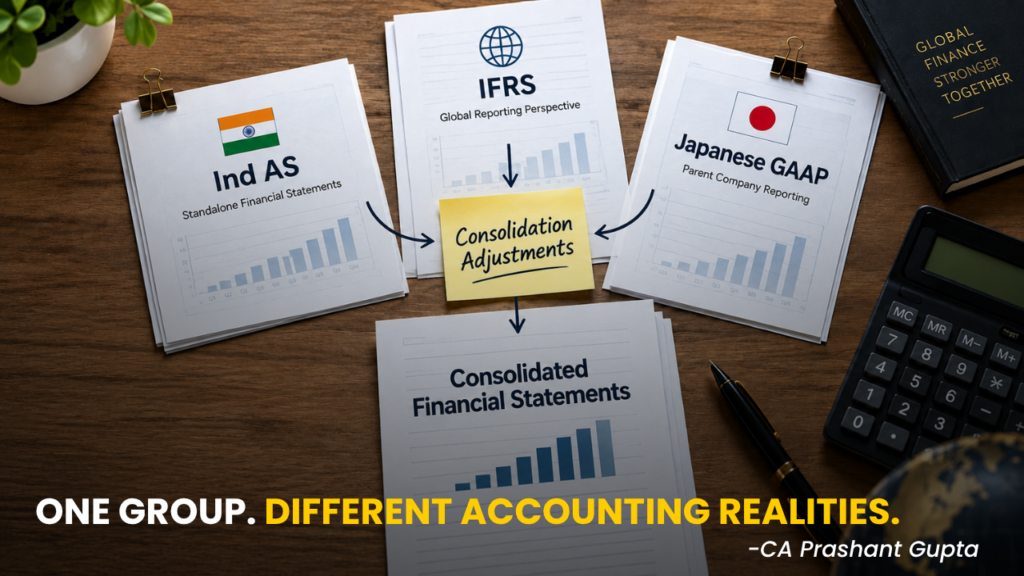
Imagine a Japanese company with a growing Indian subsidiary. The Indian finance team closes its books under Ind AS. The parent company reports under Japanese GAAP. Now the group is preparing its consolidated financial statements.
A transaction has already been recorded. The numbers are correct. The accounting teams have followed their respective standards. And yet, when the parent looks at the transaction, the accounting outcome may not look exactly the same.
So who is right? Potentially, both. That is the interesting part of group accounting.
One Transaction. Different Accounting Lenses.
Accounting standards are not simply different languages for recording numbers. They can have different recognition, measurement, presentation and disclosure requirements.
So the same underlying business event can produce different accounting outcomes depending on the reporting framework being applied.
For a multinational group, this creates an interesting situation: The subsidiary has one accounting reality. The parent has another reporting reality. And that’s where consolidation becomes important.
Think of It Like Translation
Imagine a Japanese parent and its Indian subsidiary having a conversation. The subsidiary speaks Ind AS. The parent speaks Japanese GAAP. Neither is necessarily “wrong.”
But if the group wants to present one set of consolidated financial statements, the numbers have to be brought onto a common reporting basis. That’s where group reporting and consolidation adjustments come in.
The subsidiary’s financial statements become an important starting point but they aren’t necessarily the final answer for the group.
Where Does IFRS Fit In?
The situation becomes even more interesting when the group has operations or reporting requirements involving IFRS. Now finance teams may need to understand three different frameworks:
Japanese GAAP → Ind AS → IFRS
And the challenge isn’t simply knowing the standards individually. The real challenge is understanding:
Where do they differ, and what does that difference mean for the group’s financial statements?
Why This Matters to Finance Teams
This becomes particularly important when multinational groups have:
- Indian subsidiaries
- Japanese or other foreign parent companies
- Cross-border acquisitions
- Multiple reporting frameworks
- Group reporting requirements
- Different accounting policies across entities
A local finance team may believe: “Our financial statements are compliant.” And they may absolutely be correct. But the group reporting team may still come back with: “We need an adjustment for group reporting.” That isn’t necessarily a contradiction.
It is the consequence of preparing financial information for different reporting purposes and frameworks.
Consolidation Is More Than Adding Numbers
One of the easiest misconceptions about consolidation is: Subsidiary + Parent = Consolidated Financial Statements. It isn’t that simple.
Consolidation is about bringing the financial information of different entities together while ensuring that the group is presented as one economic entity for reporting purposes.
That may require adjustments to align accounting policies and reporting requirements before the numbers tell one coherent group story.
The Real Challenge Isn’t the Standards
I’ve found that the difficult part for finance teams is often not understanding an individual accounting standard. It is understanding the interaction between standards.
A finance professional working for an Indian subsidiary may be extremely comfortable with Ind AS. But when the parent asks for numbers under Japanese GAAP or IFRS, a different set of questions appears:
- What changes?
- Why does it change?
- Which adjustments are required?
- Who owns those adjustments?
- How should they be documented?
- How do we ensure consistency every reporting period?
These questions sit at the intersection of technical accounting and practical group reporting.
The Bigger Lesson
As businesses become increasingly global, finance professionals are no longer working within a single accounting framework. A Japanese company with Indian operations, for example, may have to navigate multiple accounting perspectives before presenting one consolidated financial story.
And that’s why understanding accounting standards individually isn’t enough. You also need to understand how they connect. Because at the end of the day, consolidation isn’t about deciding which accounting reality is “right.”
It is about bringing different reporting realities together to tell one reliable story about the group.
Have you ever prepared an Ind AS financial statement only to receive a group reporting adjustment from the parent company?
What was the biggest difference you encountered?